
Maricopa County Court Records After a Jail Arrest
After a Maricopa County jail arrest, the first public record is often a booking or custody entry. The formal court record comes next. The Maricopa County Attorney's Office explains that an arrested person is booked into jail and must be taken before a Judge or Commissioner for Initial Appearance within 24 hours. At that hearing, allegations are stated, counsel rights are addressed, release conditions are set, and future dates are scheduled.
Arizona uses a County Attorney, not a District Attorney. The Maricopa County Attorney adult criminal process explains how felony charges may be filed by direct complaint or by grand jury indictment. If the person is held without bond and the County Attorney has not filed charges in a direct complaint, MCAO notes that release may occur after 48 hours. That timing explains why court records after a jail arrest may not appear at the exact moment a booking appears.
Booking records and court records answer different questions. The jail record shows custody intake, while the court file shows the filed charge, case number, hearing history, warrants, disposition, and documents available through the court or clerk. For custody lookup use Maricopa County jail inmate records; for booking photos use Maricopa County jail mugshots.
Find Maricopa County Court Records After Arrest
Felony cases are searched through the Maricopa County Superior Court Criminal Case Search. The docket home warns that entries may be audited after posting and that online data is not warranted unless backed by an original Clerk-stamped document. The docket also posts a regular maintenance window from Tuesday through Saturday, 3:00 a.m. to 4:00 a.m.
- Open the Superior Court criminal case search for felony matters after a Maricopa County arrest.
- Search by last name and first name, by initials and date of birth, or by case number when known.
- Open the matching case and review the charge list, hearing entries, warrant entries, and disposition fields.
- Use the Clerk of Superior Court for certified copies or stamped filings when legal proof is required.
Misdemeanor and limited-jurisdiction cases may be in the Maricopa County Justice Courts case search or in a city municipal court. The Justice Courts page says its online data is not the official court record. The Arizona eAccess portal can provide document-level access for eligible Superior Court criminal and civil cases filed on or after July 1, 2010, except sealed or restricted records.
The Superior Court criminal search page is shown below from the manifest capture.
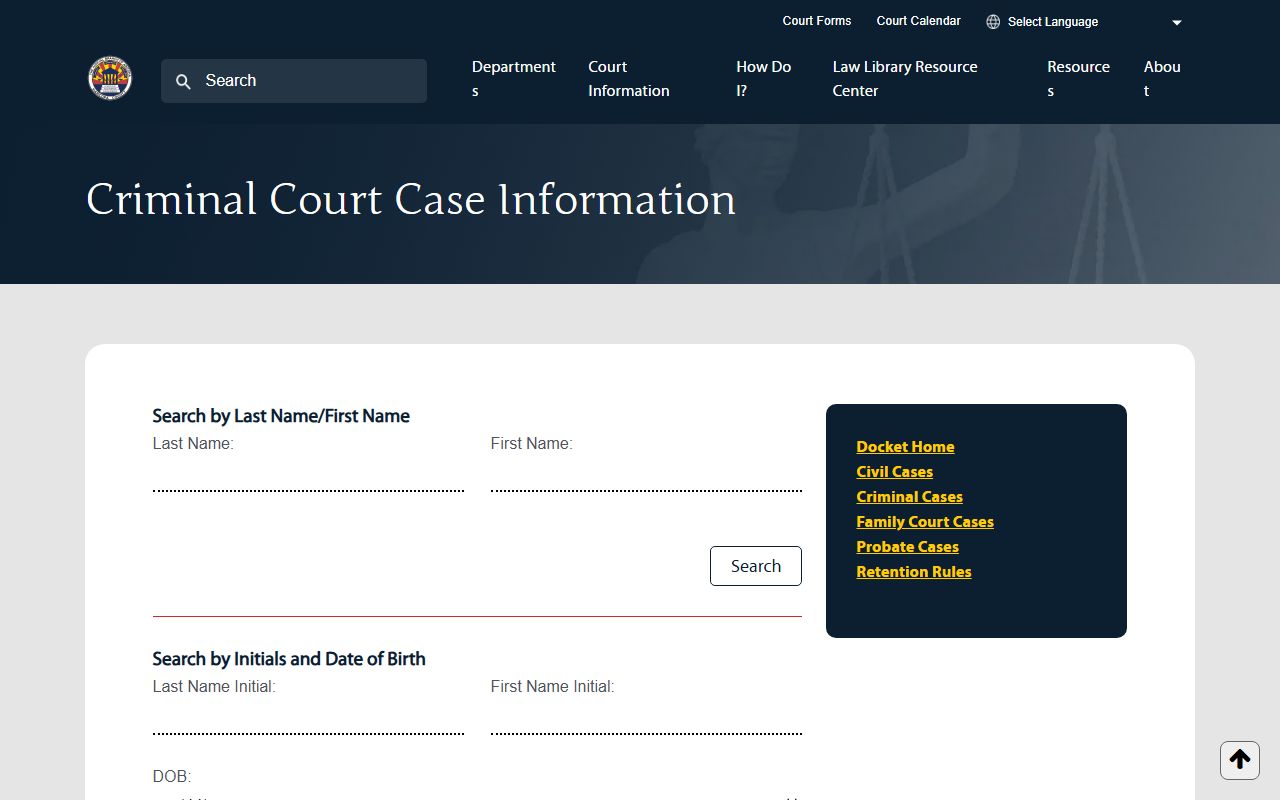
The fields support both name-based searches and case-number lookups, which is useful when a booking record has already supplied the defendant's identity.
Maricopa County Court Search Fields
The Superior Court and Justice Courts portals do not use the same search form. Superior Court supports three criminal case search modes. Justice Courts supports name, business name, and case-number tabs. A Maricopa County jail arrest can lead to either system, so the correct portal depends on charge level and the court that received the filing.
| Portal | Search Fields | Important Notice |
|---|---|---|
| Superior Court criminal search | Last name/first name, initials and DOB, or case number up to 13 characters. | Online data is not legal proof without Clerk-stamped documents. |
| Justice Courts case search | Name tab with required last name, optional first name and DOB, plus business and case-number tabs. | Online Justice Courts data is not the official court record. |
| Arizona eAccess | Document-level access for eligible Superior Court cases. | Sealed and restricted records are excluded, and fees may apply. |
Charging Documents After a Jail Arrest
The charging document is the bridge between the jail arrest and the court record. A police arrest can list suspected offenses, but the prosecutor decides what to file, decline, return for more investigation, or present to a grand jury. MCAO states that most cases begin in the Pretrial Division, which handles intake, charging, and preliminary hearings before assignment to trial divisions or specialized bureaus.
| Document | Who Files It | What It Means |
|---|---|---|
| Complaint | County Attorney | A direct complaint identifies felony offenses alleged and can lead to a summons or warrant. |
| Information | Prosecutor after required court process | A formal prosecutor charging document used in felony practice when supported by the court process. |
| Indictment | Grand jury | A grand jury charging document that may also lead to summons, warrant, and arraignment. |
Arraignment is generally held within ten days after indictment or direct complaint unless the defendant has not been arrested or has negotiated a plea at status conference. MCAO also notes that trial timing differs for people in custody and people released on bail or on their own recognizance.
Maricopa County Charge Status
Charge status can change after the arrest. A jail booking can list an arresting-agency allegation, while court records show the charge the prosecutor filed and what later happened to it. A charge can be added, amended, reduced, dismissed, resolved by plea, tried to verdict, or sealed from public view. Read each docket entry in context.
| Status | Meaning |
|---|---|
| Pending | The charge is still open and has not reached final disposition. |
| Amended or reduced | The prosecutor or court changed the filed charge, level, or wording. |
| Dismissed | The court record shows the charge was ended without a conviction on that count. |
| Plea or verdict | The case resolved through plea, bench trial, or jury trial. |
| Sealed or restricted | Public access may be limited by statute, court rule, or court order. |
Bond Records After Arrest
Bond is set in the court process, but payment in Maricopa County is tied to the jail system. MCSO says bonds and fines may be paid at the Fourth Avenue Jail Bond & Fine room, on the northwest corner of Fourth Avenue Jail. Before paying, call SIMS at 602-876-0322 with the person's full name and date of birth if the booking number is unknown. MCSO warns that release processing after bond payment may take up to 24 hours.
| Bond Type | What It Means |
|---|---|
| Cash bond | The payer posts the court-accepted cash amount directly through the accepted jail/court channel. |
| Surety bond | A licensed bail agent posts surety for release under Arizona bail practice. |
| Own recognizance | The judge releases the defendant without a cash bond, subject to court conditions. |
| No-bond hold | A court order or legal hold prevents release by bond payment alone. |
| Other agency hold | An immigration hold or another agency hold can block release even if the Maricopa County bond is paid. |
The Superior Court bond page also warns that criminal bonds are not requested by phone, text, email, or social media and cannot be paid through Zelle, Venmo, Cash App, wire transfer, or similar channels. MCSO says accepted bond payments are not refunded after acceptance, and transactions over $10,000 require a Social Security number for IRS reporting.
Warrants and Missed Hearings
A warrant can connect a court record to a new jail arrest. Maricopa County Superior Court distinguishes bench warrants and arrest warrants, and says an arrest warrant stays active indefinitely until the person is arrested or the court resolves, quashes, or cancels it. Missed hearings may appear in the criminal case search by name, initials and date of birth, or case number.
For a warrant issued by a Superior Court judicial officer in Maricopa County, Superior Court directs people to the Criminal Department Information Desk at 602-506-8575 for the division phone number. Probation-violation warrant questions are routed to Probation Violation court at 602-372-0427. MCSO also has a warrant lookup route that includes name, agency, city, and zip fields, but municipal warrants may require the issuing city court.
Charges Versus Convictions
Being arrested, booked, or charged is not the same as being convicted. Court records after a jail arrest should be read by stage. A complaint or indictment states allegations. A docket entry may show hearings, warrants, bond changes, and motions. A conviction exists only if the court record shows a plea, verdict, or judgment that creates one.
| Record Type | What It Shows | What It Does Not Prove |
|---|---|---|
| Arrest or booking | Custody intake after an alleged offense. | It does not prove a filed charge or conviction. |
| Filed charge | The prosecutor's allegation in court. | It does not prove guilt unless resolved by conviction. |
| Conviction | A plea, verdict, or judgment reflected in the court record. | It may not show jail custody status after transfer or release. |
Sealed Court Records After Arrest
Arizona court-record access is governed by court rules as well as statutes. Arizona Supreme Court Rule 123 governs public access to judicial records, including confidential and closed records. A.R.S. § 13-911 governs sealing of criminal case records in eligible situations. A sealed record may be excluded from public portals even when agencies retain nonpublic access.
| Issue | Sealed | Expunged / Destroyed |
|---|---|---|
| Public search | Often hidden or restricted by court order or rule. | Not the usual Arizona framing for ordinary case sealing. |
| Agency access | May remain available to courts or justice agencies under law. | Depends on the specific statute and order. |
| Eligibility | Controlled by A.R.S. § 13-911 and related court procedure. | Do not assume eligibility from dismissal alone. |
Restricted Maricopa Court Records
Some records are not public in full. Juvenile matters, victim information, minor-witness visual records, sealed cases, medical material, active investigative details, and security-sensitive jail information may be redacted or withheld. MCAO records requests are for prosecution records, not statewide criminal history; MCAO says criminal-history information must be requested from Arizona Department of Public Safety and municipal prosecution records from the specific city or town.
For prosecutor records, MCAO lists an online request route plus email, fax, phone, mail, drop-off, and a kiosk. The public-records custodian is at 225 West Madison Street, 3rd Floor, Phoenix, AZ 85003, with records phone 602-506-1974, fax 602-372-3844, and email mcaocor@mcao.maricopa.gov. Electronic file transfer and inspection by appointment may have no charge, while scanning, copying, redaction, or commercial-use fees can apply.
Important: Do not use informal court, jail, or mugshot searches for FCRA-covered screening decisions.